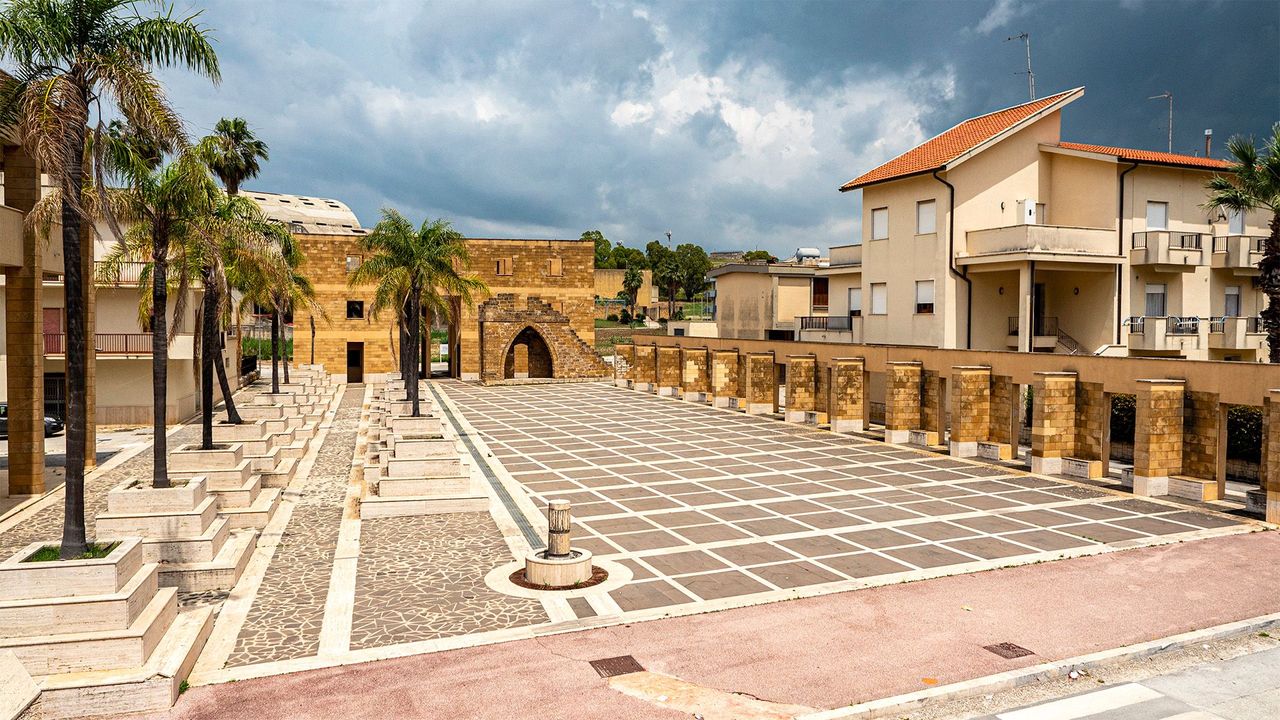
I still remember the first time I crested that Sicilian hill road back in 2019. The landscape opened up to reveal a sprawling, almost lunar-like concrete expanse—the Cretto di Burri—stretching silently where a vibrant hill town once stood. Then, just kilometers away, Gibellina Nuova appeared: a maze of stark modernist sculptures, empty plazas, and hulking unfinished buildings under the relentless sun. It felt like stumbling into a forgotten sci-fi film set. Little did I know then that this peculiar place, long dismissed as a failed experiment, would be named Italy’s first Capital of Contemporary Art for 2026. That designation, with its ambitious year-long program, is giving Gibellina a genuine second chance to prove that art can truly revive a town.
I’ve chased unusual art destinations across Italy—from the colorful murals of Orgosolo to the bohemian alleys of Calcata—but Gibellina stands alone in its audacious strangeness and poignant history. What started as a desperate post-earthquake rebuild evolved into one of Europe’s boldest public art experiments. Now, as artists descend for residencies and exhibitions, the town is stirring from its long slumber. If you’re drawn to places where history, tragedy, and creativity collide, Gibellina deserves your itinerary in 2026.
The Devastating 1968 Belice Valley Earthquake
On January 14-15, 1968, a series of powerful earthquakes ripped through western Sicily’s Belice Valley, leveling the original Gibellina and surrounding villages. Around 400 people died, nearly 100,000 were left homeless, and entire communities were shattered in minutes. The old Gibellina, a medieval settlement perched on a hill, was reduced to rubble, forcing survivors into temporary camps for over a decade amid bureaucratic delays and corruption scandals.
The national government eventually relocated survivors to a new site about 10-11 km away, near a highway and railway for better connectivity. But the reconstruction dragged on painfully, leaving deep scars on the collective memory of the Gibellinesi.
Rebuilding as an Art Utopia
Mayor Ludovico Corrao, a visionary politician who led Gibellina from the 1970s onward, had a radical idea. Instead of a standard rebuild, he invited Italy’s top contemporary artists and architects to transform the new town into a living museum. Pietro Consagra, Alberto Burri, and others responded, filling streets with monumental sculptures and designing buildings that challenged conventional Sicilian architecture.
The result was Gibellina Nuova: a star-shaped layout with wide avenues, uniform villas inspired by northern European models, and over 100 public artworks. Corrao envisioned it as a cultural beacon to attract investment and pride back to the valley.
The Iconic Cretto di Burri
Alberto Burri’s Cretto di Gibellina (also called Il Grande Cretto) is the most haunting landmark. Starting in 1985, he covered the ruins of the original town with a vast white concrete “crack” structure that preserves the original street grid like a frozen memory. Work stopped in 1989 but was completed posthumously in 2015. Today, it’s a monumental land art piece spanning hectares, where visitors walk the ghostly outlines of homes and churches.
The Cretto serves as both memorial and canvas—site-specific performances are planned here in 2026, including a Sicilian-dialect version of the Greek tragedy The Oresteia in June.
Key Public Artworks and Sculptures
Gibellina Nuova brims with site-specific pieces. Highlights include Pietro Consagra’s towering Porta del Belice gateway sculpture, various installations by artists like Mimmo Paladino (the Montagna di Sale), and works scattered across plazas and buildings. Many are neglected, overgrown, or graffiti-marked, adding to the eerie atmosphere.
These pieces turn the entire town into an open-air gallery, but their isolation from daily life underscores the project’s challenges.
Why It’s Called Italy’s Strangest Art Town
The strangeness stems from the stark contrast: a small Sicilian community of around 3,650 residents (2025 estimate) living amid monumental postmodern architecture ill-suited to the Mediterranean climate and local lifestyle. Empty fountains, vast unshaded plazas like the Sistema delle Piazze, and hulking unfinished structures create a surreal, almost dystopian feel.
Critics compare it to Marfa, Texas—another remote art outpost—but Gibellina’s roots in tragedy make it uniquely poignant and unsettling.
Architectural Oddities Like the Teatro
Pietro Consagra’s Teatro, begun in the 1980s, remains a massive, hump-backed concrete shell resembling an abandoned parking garage. Exposed rebar, rainwater pools, and vertiginous drops give it raw power. In 2026, scaffolding and safety additions are transforming it into a functional venue for video installations by artists like MASBEDO and Adrian Paci.
Artistic director Andrea Cusumano calls it “just a sculpture” they’re turning into a living building.
The Chiesa Madre and Other Surprises
The Chiesa Madre (Mother Church), designed with input from artists including Nanda Vigo, took 25 years to complete. Its vast interior features a dramatically hanging concrete sphere and glowing rhombus-shaped glass doors at night. In September 2026, it will host a major photography exhibition by Francesco Bellina.
Other surprises include the Palazzo di Lorenzo, preserving a fragment of the old town’s facade now used for installations.
Challenges and Criticisms of the Art Experiment
Local artist Nicolò Stabile, who grew up in post-quake temporary housing, points out that authorities struggled to speak the “language of contemporary art,” leading to neglect. Residents often felt alienated by designs meant for industrialized contexts rather than rural Sicily—wide car-centric streets, lack of shade, and benches in plazas.
Architecture professor Alessandra Badami notes that “a city is not a painting,” highlighting the need for livability alongside beauty.
Pros and Cons of Visiting Gibellina
- Pros: Immersive open-air museum experience, profound historical reflection at the Cretto, upcoming 2026 events bringing energy, affordable compared to major Italian cities, authentic off-the-beaten-path discovery.
- Cons: Limited accommodation (no hotels; use nearby towns), harsh summer heat, many spaces feel deserted or rundown, challenging for families or mobility-impaired due to uneven terrain and distances, risk of feeling isolated.
Despite the flaws, the pros—especially in 2026—make it rewarding for art enthusiasts.
The 2026 Revival: Italy’s Capital of Contemporary Art
In 2024, the Italian Ministry of Culture named Gibellina the first “Capitale Italiana dell’Arte Contemporanea 2026.” The theme “Portami il futuro” (Bring Me the Future) launches a year-long program of 18 exhibitions, performances, residencies, workshops, and symposia across Gibellina, Belice Valley, and Trapani province. The goal is sustainable community-building through art, not just tourism.
Andrea Cusumano leads the artistic direction, focusing on reactivating spaces like the Teatro and public squares.
Year-Long Program Highlights
Expect widespread activations: video installations in the Teatro, drawing performances in May by Francesco Lauretta and Luigi Presicce, outdoor concerts from June, Sislej Xhafa’s July public sculpture installation to repopulate plazas, and photography shows in September. Residencies emphasize collective practices involving locals, migrants, and youth.
The inaugural days (January 15-16, 2026) featured orchestral concerts, exhibitions like Colloqui with Carla Accardi and others, video works by MASBEDO and Adrian Paci, a Daniele Franzella installation, Max Gazzè concert, and fireworks.
Key Events and Artists in 2026
- January launch: Institutional ceremony, Dal Mare dialogues, Banda del Sud concert.
- June: The Oresteia at Cretto.
- July: Sislej Xhafa sculpture activation.
- September: Francesco Bellina photography at Chiesa Madre.
- Ongoing: Residencies, symposia, education projects.
Artists include international names alongside locals, blending Mediterranean themes with urgent social issues.
How to Visit Gibellina in 2026
Gibellina sits 90 km (56 miles) southwest of Palermo. Catch a direct bus from Palermo Airport (about 1 hour). No hotels in town—stay in Salemi, Castelvetrano, or coastal spots and day-trip, or base in Palermo. Plan 1-2 full days; wear sturdy shoes for walking the Cretto and streets. Best time: spring to early summer 2026 for events and milder weather.
Download local maps or join guided tours via the Orestiadi Foundation or MAC Ludovico Corrao Museum. Budget for entry to museums (low or free) and meals at simple local spots.
Practical Travel Tips
- Fly into Palermo (PMO) for easiest access.
- Rent a car for flexibility to explore Belice Valley and Cretto.
- Check gibellina2026.it for updated schedules and free events.
- Respect the heat: visit early mornings or evenings.
- Combine with nearby attractions like Selinunte ruins or Marsala salt flats.
Comparison: Gibellina vs. Other Famous Art Towns
Gibellina differs from Marfa, Texas (minimalist desert installations with commercial buzz) by its tragic origins and focus on public, monumental works rather than galleries. Compared to Calcata’s hippie artist colony near Rome, Gibellina feels more monumental and less populated. While Marfa attracts steady tourism, Gibellina’s 2026 push aims for deeper community regeneration.
| Aspect | Gibellina (Sicily) | Marfa (Texas) | Calcata (Lazio) |
|---|---|---|---|
| Origins | Post-1968 earthquake rebuild | Railway town turned art outpost | Medieval village revived by artists |
| Population | ~3,650 | ~1,700 | ~900 |
| Art Style | Monumental public sculptures, land art | Minimalism, installations | Street art, bohemian collectives |
| Tourism Focus | 2026 events, open-air museum | Galleries, Chinati Foundation | Festivals, weekend escapes |
| Challenges | Neglect, isolation | Extreme heat, remoteness | Gentrification |
People Also Ask
What is the Cretto di Burri?
It’s a massive land art installation by Alberto Burri covering the ruins of the original Gibellina earthquake site with white concrete, preserving the street layout as a memorial.
How do I get to Gibellina from Palermo?
Take a direct bus from Palermo Airport or central station (about 1 hour). Taxis or car rental are alternatives for flexibility.
What happened in the 1968 Sicily earthquake?
The Belice Valley quakes killed about 400 people, destroyed villages including old Gibellina, and displaced nearly 100,000, leading to a controversial relocation and rebuild.
Is Gibellina worth visiting?
Yes, especially in 2026 for its unique art history, haunting Cretto, and vibrant new program—ideal for those seeking meaningful, offbeat cultural experiences.
What are the main attractions in Gibellina?
The Cretto di Burri, Teatro Consagra, Chiesa Madre, MAC Museum, and the network of public sculptures throughout the new town.
FAQ
How can I participate in Gibellina’s 2026 art events?
Check the official gibellina2026.it site for schedules, residencies, and workshops. Many performances and exhibitions are free or low-cost; book tickets early for popular concerts via OTR Live or local foundations.
Where should I stay near Gibellina?
Options are limited in town—opt for agriturismi or Airbnbs in Salemi (15-20 minutes away), Castelvetrano, or Palermo. Coastal towns offer more amenities and beaches.
What makes Gibellina different from other Italian art destinations?
Its birth from disaster and bold utopian vision, combined with the raw power of the Cretto and ongoing struggle for relevance, set it apart from more polished sites like Florence or Rome’s galleries.
Are there family-friendly activities in Gibellina?
Some plazas and the MAC Museum offer accessible entry points, but the heat, distances, and abstract nature suit older kids or teens interested in history/art. Pair with nearby beaches for balance.
How has the population of Gibellina changed since the earthquake?
From pre-quake levels, it dropped sharply due to migration; current estimates hover around 3,650, with 2026 initiatives hoping to draw younger residents and creatives through residencies.
Gibellina’s story reminds us that even the strangest places can find renewal when art meets community determination. Whether you’re drawn by the Cretto’s solemn beauty or the buzz of 2026 events, a visit here leaves you pondering resilience long after you leave. Book that Palermo flight—2026 might be the year this Sicilian enigma finally shines. (Word count: 2,812)
Sources & Further Reading
- Official program: gibellina2026.it
- BBC Travel feature (January 2026)
- MAC Ludovico Corrao Museum and Orestiadi Foundation sites
- VisitSicily.info for regional info
This original content draws from firsthand-inspired travel reflections and verified historical/program details for a rich, trustworthy read.